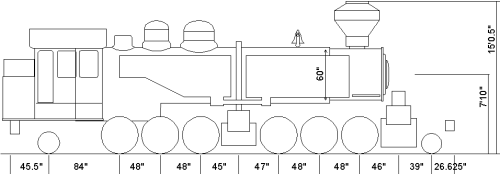
Baldwin Class: 16-28/46-1/4-DD, 4
Type: 2-6-6-2T
Baldwin Code Word, RECTORADO
Tank or tender type: Split Side Tanks
Build date: January 1910
Baldwin Construction Number: 34215
Tractive Force: 37,800 lbs.
|
Gauge: 4'8.5" (standard gauge) Cylinders: 17" and 26" x 24" Valves: Balanced Slide Boiler:Type: Straight Material: Steel Diameter: 60" Thickness of Sheets: 5/8" Working Pressure: 200 lbs. Fuel: Wood, later oil Staying: Radial Firebox:Material: Steel Length: 90 3/16" Width: 42" Depth: front, 65 3/4"; back, 59 3/4" Thickness of Sheets: sides, 3/8"; back, 5/16"; crown, 3/8"; tube, 1/2" Water Space, front, 4"; sides, 3"; back, 3"
|
TubesMaterial: Steel Thickness: No.12 W.G. Number: 221 Diameter: 2" Length: 17'0" Heating SurfaceFirebox: 132 sq. ft. Tubes: 1,957 sq. ft. Total: 2,089 sq. ft. Grate Area: 26.3 sq. ft. Driving WheelsDiameter Outside: 44" Diameter of Center: 38" Journals, main: 7.5" x 8" Journals, others: 7" x 8"
|
Engine Truck WheelsDiameter, front: 24" Journals: 4.5" x 7.5" Diameter, back: 26" Journals: 5" x 8" Wheel BaseDriving: 23' 8" Rigid: 8' 0" Total Engine: 37' 9" WeightOn Driving Wheels: 177,200 lbs. On Truck, front: 13,950 lbs. On Truck, back: 14,800 lbs. Total Engine: 205,950 lbs. Tank CapacityWater, 2,000 gals. Wood, 4 tons. Later Oil, 1,000 gals.
|
1910-1945: Booth Kelly Lumber Company #2. Wendling, OR.
1947: Scrapped, Wendling, OR.
Built in January 1910, the Booth Kelly Lumber Company's #2 was the first tank-type Mallet built for logging service, and was also the first of Baldwin's more or less standard model 44" driver logging Mallets. Like most Baldwin Mallets of the period #2 used saturated steam, and all four cylinders had slide valves. The split side tank design used on #2, and later on Booth-Kelly #6 and the two St. Paul & Tacoma Mallets, was used to accommodate the steam delivery pipes to the high-pressure cylinders.
Booth-Kelly Lumber Company's logging railroad operated in the area around Wendling, Oregon, northeast of Eugene. Baldwin's Record No. 68 Mallet Articulated Locomotives notes that Booth-Kelly was operating #2 on fifty-six pound rails with six and one half percent grades and thirty-five degree curves, and #2 could be used on up to nine percent grades. #2 was successful in service, although it was the only logging Mallet of its type until 1920 when Booth-Kelly #6 was ordered. In his book A History of the Mohawk Valley and Early Lumbering, Booth-Kelly employee Louis Polley recalls #2 was used as a road engine, and would usually haul about twenty loaded cars to the mill per day. By the 1940s Booth-Kelly generally used skeleton log cars, although before 1920 flat cars equipped with logs bunks were used. #2 operated until 1945, when it and Booth-Kelly's other steam locomotives were retired. The locomotive remained in storage until 1947 when it was scrapped.
-Booth Kelly #2 was the first tank Mallet built for use in North America
-Unknown date, before conversion to oil. Single-phase air pump added to engineer's side of smokebox. Originally had single-phase air pump on fireman's side only.
-Unknown date, before conversion to oil: Portion of cab wall between door and second window removed.
-1913, converted from wood to oil firing. Radley & Hunter stack replaced with straight stack.
-Unknown date: Dynamo added between bell and steam dome, headlights converted to electric power.
-Unknown date: Compound air pumps added to both sides of smokebox.
-Unknown date: headlight moved from pilot deck to in front of stack.
-Unknown date: Rear light moved from back of fuel bunker to cab roof.
Booth-Kelly #2 out of service at Wendling, OR in Dec 1947 - Martin E. Hansen Collection
-1975: Northwest Short Line of Seattle, WA imported HO scale brass models of #2 as it appeared after modifications.
-1980s: Mantua Metal Products introduced their "Booth-Kelly Logger" variation of their HO scale 2-6-6-2. It was offered in both kit and ready to run form, usually painted in various freelance schemes, but occasionally offered as Booth-Kelly #2. An early 1990s version had a Radley & Hunter stack. Mantua HO scale Booth-Kelly Logger, early 1990s version.
1. Baldwin Locomotive Works, Record No. 68: Mallet Articulated Locomotives. Baldwin Locomotive Works, Philadelphia, PA. 1910
2. Schmelzer, Ken. "Logging Mallets: Part 4." Narrow Gauge & Short Line Gazette. May 1976.
3. LeMassena, Robert A. Articulated Steam Locomotives of North America. Sundance Publications, Limited, Silverton, CO. 1979.
4. Polley, Louis E., assisted by Sue Bailey. A History of the Mohawk Valley and Early Lumbering. Polley Publishing, Marcola, OR. 1984.


